Forum on International Legal History & Philosophy (in India) (CfP)

CHANAKYA NATIONAL LAW UNIVERSITY, PATNA

Forum on International Legal History & Philosophy, 15 April 2026 (in-person)

Call for Papers and Engaged Listeners

About: This Call for ideas (in the form of detailed abstracts) invites scholars working in International Law, Constitutional Law, and Legal Philosophy, whether individually or through interdisciplinary approaches. The contours of the forum are outlined below in two overlapping and porous themes.

Aims: We intend to stimulate discourse on international legal history and theory employing regional and archival lens. We expect a rough sketch of your clearly formulated idea to make such stimulations. We aim to discuss the vitality of your research ideas for them to be transformed into future research (beyond this forum).
More details in the pdf, here.

dharma and adharma are not “virtue” and “vice” (in Medhātithi)

G. Jhā was an amazing scholar and translator, but he produced so much that he could not revise in detail his translation choices and some infelicities are kept in the published versions of his translations.

One such cases is “sinful” or “vicious” for adharma and “moral” or “virtuous” for dharma in the translation of Medhātithi’s commentary. I am sure that there are cases in which such a translation could make sense, but not in Medhātithi.

Medhātithi follows the Mīmāṃsā approach and defines dharma as what is prescribed by the Veda or is in line with the duties prescribed by the Veda and adharma as its opposite. Translations such as “sinful” or “virtuous” suggest that actions have an intrinsic moral value logically prior to the commands applied to them. By contrast, this is not the case. Violence is not adharma because it is intrinsically “sinful” or “vicious” and in fact Medhātithi explains that the Jyotiṣṭoma violence is not adharma at all.

Punishing? Yes, but not through violent means (acc. to Medhātithi)

The reasoning by Medhātithi on 8.316 (on punishment and why it does not violate the prohibition to perform any violence) is quite complex and multiple opponents discuss. I will list them below attributing a number to each one of them.

1. A first opinion being discussed is that, since punishment is enjoined (presumably: as part of the duty to protect people) and prohibited (by the prohibition to inflict any violence), it is optional. “Option” (or “free picking”, vikalpa) is in general to be avoided and Mīmāṃsā authors would accept it only for details bearing no great significance. Hence, the opinion is dismissed.

2. Next, a second speaker observes that no vikalpa applies, because violent punishment is clearly forbidden by the prohibition to perform any violence.

3. Rebuttal: It is not forbidden because it is performed as part of fulfilling one’s duty.

2a. Second speaker again: in order for the prohibition to perform violence not to apply, the act of (violent) punishment should be enjoined, as it happens in the case of the Agnīṣomīya (a sacrifice which involves violence, and which is not blocked by the prohibition to inflict violence).

3a. Violent punishment is enjoined through worldly experience, hence no prohibition affects it.

2b.The second speaker then expands on the above point and observes that there is no specific prescription about violent punishment, since punishment is only derived from the duty to protect people, but this duty could be fulfilled also through other means (e.g., reprimanding people). Hence, inflicting violent punishment is not enjoined as a duty and it is just a worldly act (and, as such, liable to be blocked by the prohibition). Similarly, if one were to perform a sacrifice leading to a violent result because one desires it, as it happens in the case of the Śyena, that sacrifice would be blocked by the prohibition to perform violence.

2c. The second speaker also belabours on the difference between instrumental and resultative violence, saying that in the case of the śyena violence is prompted by desire, whereas in the case of the Agnīṣomīya, it is merely subsidiary.

2d. If violent punishment were specifically prescribed, then we would have to resort to vikalpa (as discussed above).

Thus, the conclusion appears to be that violent punishment should not be resorted to as a consequence of the duty to protect, although (as discussed in my article on corporal punishment) it can be resorted to in order to purify the culprit.

Permissions, rights and adhikāra

As discussed in previous blogposts and articles, it is established that in Mīmāṃsā and Mīmāṃsā-following Dharmaśāstra all commands are dyadic; prescriptions, prohibitions and permissions are not interdefinable; permissions are always exceptions to previous prohibitions or negative obligations, and they are better-not permissions.

Permissions in Medhātithi: Two examples

Case 1:

Manu:

etān dvijātayo deśān saṃśrayeran prayatnataḥ |
śūdras tu yasmiṃs tasmin vā nivased vṛttikarśitaḥ || 2.24 ||

Medhātithi thereon:
śūdrasya dvijātiśuśrūṣāyā vihitatvāt taddeśanivāse sarvadā prāpte tatrājīvato deśāntaranivāso ’bhyanujñāyate.

So, living in another place (deśāntaranivāsaḥ) for a śūdra is permitted, if he cannot get a living where the twice-born ones live, because a śūdra is prescribed (vihita) to obey the twice-born ones. What we see is:

—the permission is a better-not option

—a specific permission is always parasitical on a general (sarvadā prāpte) prohibition or negative obligation (in this case: it is prohibited to live elsewhere, in turn depending on the duty to serve).

Case 2:

Manu:

strīṇāṃ sukhodyam akrūraṃ vispaṣṭārthaṃ manoharam | maṅgalyaṃ dīrghavarṇāntam āśīrvādābhidhānavat || 2.33 ||

Medhātithi:
puṃsa ity adhikṛtatvāt strīṇām aprāptau niyamyate | sukhenodyate sukhodyam | strībālair api yat sukhenoccārayituṃ śakyate tat strīṇāṃ nāma kartavyam | bāhulyena strīṇāṃ strībhir bālaiś ca vyavahāras teṣāṃ ca svakaraṇasauṣṭavāb- hāvān na sarvaṃ saṃskṛtaṃ śabdam uccārayituṃ śaktir asti | ato viśeṣeṇopadiśy- ate | na tu puṃsām asukhodyam abhyanujñāyate |

So, girls lack the śakti to pronounce Sanskrit words, hence they need easy- to-pronounce names. This command is taught explicitly with regard to them because of their inability, but it does not mean that difficult names are permitted for men.

Noteworthy here:

—The opponent is suggesting that F(x/y)—>P(x/¬y) —Medhātithi explains that this is wrong. It is true that P(x/¬y)—>F(x/(y∧¬y)) but the opposite is not true.

Rights and adhikāra


Having permissions just as exceptions means that they cannot be used to ground the notion of right (as in Hansson 2013). What else can correspond to “rights”?

• 1. There does not need to be a corresponding term. The deontic horizon is, like any other partition of the cognitive world, arbitrary.

• 2. There can be functional equivalents, one of which is adhikāra, I think.

adhikāra is connected to ability (sāmarthya and śakti), in the sense that unless there is ability, there is no adhikāra. Differences: adhikāra also implies duty. Contexts in which adhikāra is discussed: poor people having adhikāra, because they still have the śakti, although they momentarily lack the sāmarthya (all in ŚBh ad 6.1.1–3); disabled people lacking adhikāra for sacrifices but having adhikāra for svādhyāya (TV ad 1.3.4).

Permissions in Dharmaśāstra

Vijñāneśvara’s Mitākṣarā commentary on Yājñvalkya 3 (on expiations), v. 35, explains that even in case of distress a non-Brāhmaṇa cannot take up the profession of a Brāhmaṇa and a Brāhmaṇa cannot take up that of a Śūdra. The commentary on v. 35 also explains that one will need to undergo an expiation ritual (prāyaścitta) because of having undertaken the occupation of another varṇa, once the difficult times are over (see Kumārila’s similar point in text a about expiable permissions). This suggests that

P(taking up the occupation of a kṣatriya or vaiśya varṇa)/being a Brāhmaṇa in distress (and so on for the further varṇas)

is to be understood as an exception to a previous prohibition:

F(perform the occupation of a kṣatriya, vaiśya and śūdra/Brāhmaṇa)

and not of a negative obligation.
It also seems to mean, as Timothy Lubin suggested (Nov 25), that there is no *F(self-harm)/T, since it may happen that taking up the occupation of a Brāhmaṇa would be the only way to avoid dying by starvation, but this still does not lead to a duty to undertake such an occupation.

Moreover, the picture gets more complicated.
In fact, vv. 37–39 explain that

P(taking up the profession of a vaiśya)/(being a Brāhmaṇa in distress)

has some counter-exceptions, namely prohibitions applying to it, e.g.

F(selling weapons)/being a Brāhmaṇa in distress who has taken up the occupation of a vaiśya

Thus, it is possible to have prohibitions within permissions (that are in turn exceptions of other prohibitions)

♦P(x/y) /\ F(z/x)

Then, there is a counter-counter exception, namely:

F(selling/Brāhmaṇa) /\ P(selling/Brāhmaṇa in distress) /\ F(selling sesame/Brāhmaṇa in distress) /\ P (selling sesame in exchange for grain/Brāhmaṇa who can’t perform rites for want of grain).

The commentary quotes Manu 10.91 explaining that if one were to sell sesame in exchange for something else, one would be harshly sanctioned (one will be born again as dog).
v. 41 and commentary explain that the previous permissions are clearly “better not” and that they come with some cost, whereas accepting gifts in case of distress is alright.
So (like in Kumārila, text a above), there are two levels of permissions:

F(selling/Brāhmaṇa)

P1(selling/Brāhmaṇa in distress) —>O(expiation/end of distress) \/ bad karman

P2(accepting gifts/Brāhmaṇa in distress)—>no bad karman

v. 43 (on stealing) follows at that point.
It reads as follows:

bubhukṣitas tryayaṃ sthitvā dhānyam abrāhmaṇād dharet |

pratigṛhya tad ākhyeyam abhiyuktena dharmataḥ ||

“If one has been hungry for three days, he might take some grains from someone who is not a Brāhmaṇa |

If he takes it and is accused, he must say it, according to duty (dharma) ||”

NB: F(stealing)/T is overrun by P(stealing)/not having eaten for three days, provided one is stealing only from a non-Brāhmaṇa (thus presupposing F(stealing from a Brāhmaṇa)/T). The Mitākṣarā commentary
further explains that one can only take enough for one meal and cannot take additional supplies, thus presupposing P(stealing a minimal amount to avoid starvation)/not having eaten for three days.
Now, if one goes on like that for a long time, one might eventually die of starvation (because one is stealing only enough for one meal and only once every three days). v. 44 suggests the solution (the king should take care of one), but this is not a solution one can count on in every case. Hence, v. 43 does not a rule out a situation in which, in order to avoid violating the prohibitions at stake (F(stealing)/T, weakened by P(stealing from a non-Brāhmaṇa/not having eaten for 3 days) and F(stealing from a Brāhmaṇa)/T)) one ends up actually dying.
This further strengthens the point that there is no O(avoid starvation) as the result of F(harm)/T.

The commentary introducing v. 43 states that P(stealing from a non-Brāhmaṇa/distress) only applies to people who have tried all of the above. I am not sure about how to formalise the temporality factor, perhaps something like:

F(selling/Brāhmaṇa)

P1(selling/Brāhmaṇa in distress) /\ distress—>
P1(stealing/Brāhmaṇa in distress)

NB: Kumārila had distinguished between P1 and P2, but by saying that P1 are “general permissions” and P2 specific ones, that is ones explicitly mentioned in text, whereas here P1 can be specifically mentioned and still involve some bad karman.

Appendix: Kumārila, TV ad 1.3.4, text a

[In one case, that of hardship] one does something even without permission, because there is no other way |

[in the other case, that of supererogatory permissions,] one does something else on the strength of a permission: the difference is major ||

And there is a difference between the specific [permission] and the permission (abhyanujñāna) in general (to adopt looser rules in times of hardship) |

[In fact,] the specific [permitted action] is completely free of flaws, the other action has a little (stoka) flaw ||

ekaṃ vināpy anujñānāt kriyate gatyasambhavāt | kriyate ‘nujñayā tv anyad viśeṣaś ca tayor mahāh ||

sāmānyenābhyanujñānād viśeṣaś ca viśiṣyate | viśeṣo ‘tyantanirdoṣaḥ stokadoṣetarakriyā ||

Is the Mitākṣarā just not following Kumārila when it says that even a specific permission can imply bad karman and the need of an expiation? Is Kumārila trying to systematize a complicated series of cases? Or am I missing something altogether?

Medhātithi on corporeal punishment

Medhātithi discusses corporeal punishments whenever Manu does, but in two different ways: At times (e.g., in his commentary on MDhŚā 9.248) he just repeats what Manu says, without adding further elaborations and without attempting a general argument about the overall consistency of the punishments suggested. At other times, he allows the jurist and philosopher of law within himself to talk and gives more details about the purpose of the punishments. These are the passages I will focus on in this post.

1. Terminology: One of the things not completely clear in MDhŚā (and consequently in Medhātithi’s commentary thereon) is what kind of corporeal punishment are meant by māraṇa ‘imposing death’, hiṃsā ‘violence’ and vadha ‘killing’. All could just mean ‘death penalty’ (and hiṃsā and māraṇa are used in the commentary on MDh 8.318 as if they were synonyms). However, in other cases other forms of corporeal punishment (śārīra daṇḍa) are mentioned, e.g., aṅkana ‘branding’ (so Medhātithi on 9.236). Could these be included within maraṇa, vadha and hiṃsā as well? It will be evident in the following that Medhātithi takes advantage of each vagueness in MDhŚā in his efforts to make the text consistent.

Medhātithi on 9.249 comments on a passage speaking of vadha, but ex- plicitly broadens the concept, so as to encompass other types of punishment apart from death penalty. It is noteworthy that he mentions two topics that will be highlighted also in section 3.3, namely holding back crimes as a purpose of punishment, and the distinction between visible and invisible purposes:

“This mention [in the MDhŚā] of vadha is for the sake of summarising (upasaṃhṛ-) suppressive [punishments] (nigraha). Therefore, according to the law code (yathāśruti) this vadha can occur through various manners. In this context, given that the mention of vadha [in the MDhŚā] is meant for the sake of perceptible purposes, it does not need to be necessarily a killing. Such being the case, there is no flaw if [the punishment] is realised also through other means, e.g. detention (bandhana).”

(nigrahopasaṃhārārthas tv ayaṃ vadhopadeśaḥ. ato yathāśruti citravadhopāyaiḥ kartavyaḥ. […] tatra dṛṣṭaprayojanatvād upadeśasya na niyato vadhaḥ. evaṃ ca saty upāyāntareṇāpi bandhanādinā ’viniyacchato’ na doṣaḥ.)

2. Multiple purposes for corporeal punishments: In the commentary ad MDh 8.324 Medhātithi discusses the different pun- ishments (ranging from a fine to beating and to death) for stealing, as pro- portioned to the moment in which the stealing has been committed and to the purpose which could have been fulfilled by the stolen item. For instance, stealing war animals during a war encounters a more severe penalty than stealing them at a normal time. Similarly, stealing a rare medicine when it would have been needed by a certain patient encounters a severe punishment, whereas stealing the same medicine when no one needs it receives a smaller punishment. The mention of paying a fine vs death as punishment in the various circumstances in which one could steal a sword strongly suggests that fines are considered the smaller punishment.

3. Corporeal punishment vs. fines: Notwithstanding what has been seen in section 2, the choice between fines and corporeal punishment is not just driven by the severity of the crime.

The passage I will analyse here is the commentary ad MDh 8.318. Looking back at the Mīmāṃsā 6-fold dialectical scheme above, the topic here is corporeal punishment, even though it remains implicit. The doubt is also implicit, but it can be reconstructed as: Does corporeal punishment have an invisible purpose? A further implicit background assumption only became clear to me at the end of my analysis: There are either monetary punishments or corporeal ones.

Thus:

• topic: corporeal punishment [implicit]
• doubt: Does corporeal punishment have an invisible purpose? [implicit]

1st speaker (Medhātithi): punishment in the form of fines is useful to the king (implicit: because he earns money), [hence] corporeal punishment must be useful to the person who undergoes it.

2nd speaker (Obj): No, it is needed for the sake of protecting other people from crimes.

(Medhātithi): Why should protection not be possible without hurting?

(Obj): Without the hurt, the person would repeat the act

(Medhātithi): This could be achieved also by reprimanding them etc.

(Obj): By seeing them punished, others would desist.

(Medhātithi): The suffering could be brought about even by fines.

(Medhātithi): Moreover, even though criminals are punished, thousands of people are found to do the same act again and again!

Conclusion: Corporeal punishment purifies the person who undergoes it by creating an invisible force, so that they can be admitted to heaven like innocent people, as said by Manu. What follows at this point seems a redundant addition, since it seems to come after the conclusion:

  • 1. There are restrictions concerning the cutting off of limbs…
  • 2. Also prescriptions such as the one about the elephant, etc.
  • 3. Therefore, it is established that one is liberated from one’s bad karman only once there is corporeal punishment,
  • 4. And analogously, branding (aṅkana) will be prescribed in the case of major offenders, to whom everything has been confiscated, and who are punished by entering into water, so that people avoid getting in touch with them. The figure below summarises the whole discussion.

4. Unspoken strategies: Medhātithi does not feel the need to spell out strategies and premisses he is mostly reusing from Mīmāṃsā.

The first unspoken premiss of Medhātithi is: Never question the juridical corpus one is commenting upon, just try to make sense of it (as Mīmāṃsā authors do with the Veda). This means that Medhātithi cannot conclude that corporeal punishments should be avoided. He can discuss the why, not the whether. Correspondingly, the juridical corpus can be interpreted, not refuted.

The second unspoken assumption is: Every action needs a purpose (cf. prayojanam anuddiśya na mando’pi pravartate, Kumārila). This leads to the conclusion that punishment needs a purpose.

A third unspoken assumption is that there is a distinction between visible and invisible purposes (dṛṣṭa and adṛṣṭa in Mīmāṃsā terminology).

This is accompanied by the forth unspoken assumption, namely, the preference for visible purposes whenever possible, and by the fifth one, namely that only one purpose is possible (ekārthatā), both of which borrowed from Mīmāṃsā. Therefore, Medhātithi only concludes that corporeal punishment has an invisible purpose once he has ruled out possible visible ones.

A sixth unspoken assumption is that ceteris paribus, we should not harm any living being, because of the Vedic prohibition “One should not harm any living being” (na hiṃsyāt sarvā bhūtāni), largely discussed in Mīmāṃsā.

5. Corporeal punishment and adultery: As seen above, corporeal punishments are not a deterrent to crime (although they can have other purposes). However, Medhātithi ad 8.359 seems to admit of corporeal punishments as deterrent, while discussing punishments for adultery. The passage reads as follows:

“If by [minor things] like talking together there were only a minor penalty, then people would keep acting. Then, inflamed by the deity of love, overpowered by another conversation with another man’s wife, and attracted by the arrows of love, they would consider the king’s correction as negligible and disregard [even] their bodies’ sustenance.

By contrast, if by the first undertaking they were caught, it would be possible to drive them away, given that their desire has been interrupted (aprabandhavṛtti). Hence, it is correct to have major penalties even for people just whispering to other people’s wives.”

Is this passage in sheer contradiction with the previous one? Should not fines be enough? This question brings us back to the kind of Mīmāṃsā Medhātithi is following, which is possibly a Maṇḍana-flavoured Bhāṭṭa Mīmāṃsā in which the addressee of a command can evaluate costs and benefits (for instance, of fines and theft). However, in the case of love and lust, people are unable to calculate costs and benefits. Hence, the only way to protect women is by eliminating their potential seducers. Thus, corporeal punishment in those cases might just aim at making adultery impossible by removing the potential seducer.

6. Conclusions: Punishments are prescribed by Manu on different bases. Medhātithi partly tries to systematise Manu’s lore and in several cases discusses a multifaceted structure of punishments. For instance, in the commentary on MDhŚā 8.334 Medhātithi specifies that Manu’s reference to the cutting of a limb as a punishment for theft only regards “one who is repeatedly addicted to stealing” (transl. by G. Jhā) after they have been repeatedly fined. This is relevant as a harmonising comment, because the previous verses of Manu had mentioned fines.

According to Medhātithi, punishments can be nuanced based on multiple factors. The first and main factor is the purpose to be achieved by the punishment: discouraging crimes (e.g., stealing weapons during war is severely punished in the commentary on MDhŚā 8.324), making crimes literally impossible (as in the case of adultery in the commentary on 8.359) allowing the king to increase their financial resources (commentary on 8.318), warning other people that they are dealing with a convicted criminal (commentary on 9.236), purifying the criminal (commentary on 8.318). This means that although fines are in principle a smaller punishment than corporeal punishments, they can be the preferred option depending on the purpose to be achieved with the punishment.

For some random crimes, such as stealing in normal circumstances, Medhātithi does not aim at eradicating them completely, hence fines are the best strategy (they discourage crimes while increasing the king’s finances). Other crimes (such as adultery, stealing medicines from sick people or stealing a weapon from a person who is directly confronted by an armed enemy) are seen as more threatening and therefore need to be actively discouraged or literally made impossible with extreme measures.

The broadest systematising effort by Medhātithi with regard to punishments seems to occur in his commentary on 8.318, where he lists all punish- ments as being either for the benefit of the punisher (fines, benefitting the king) or for the benefit of the punished (corporeal punishments, purifying the criminal).

Does the reconstruction above convince you? Do you notice other strategies?

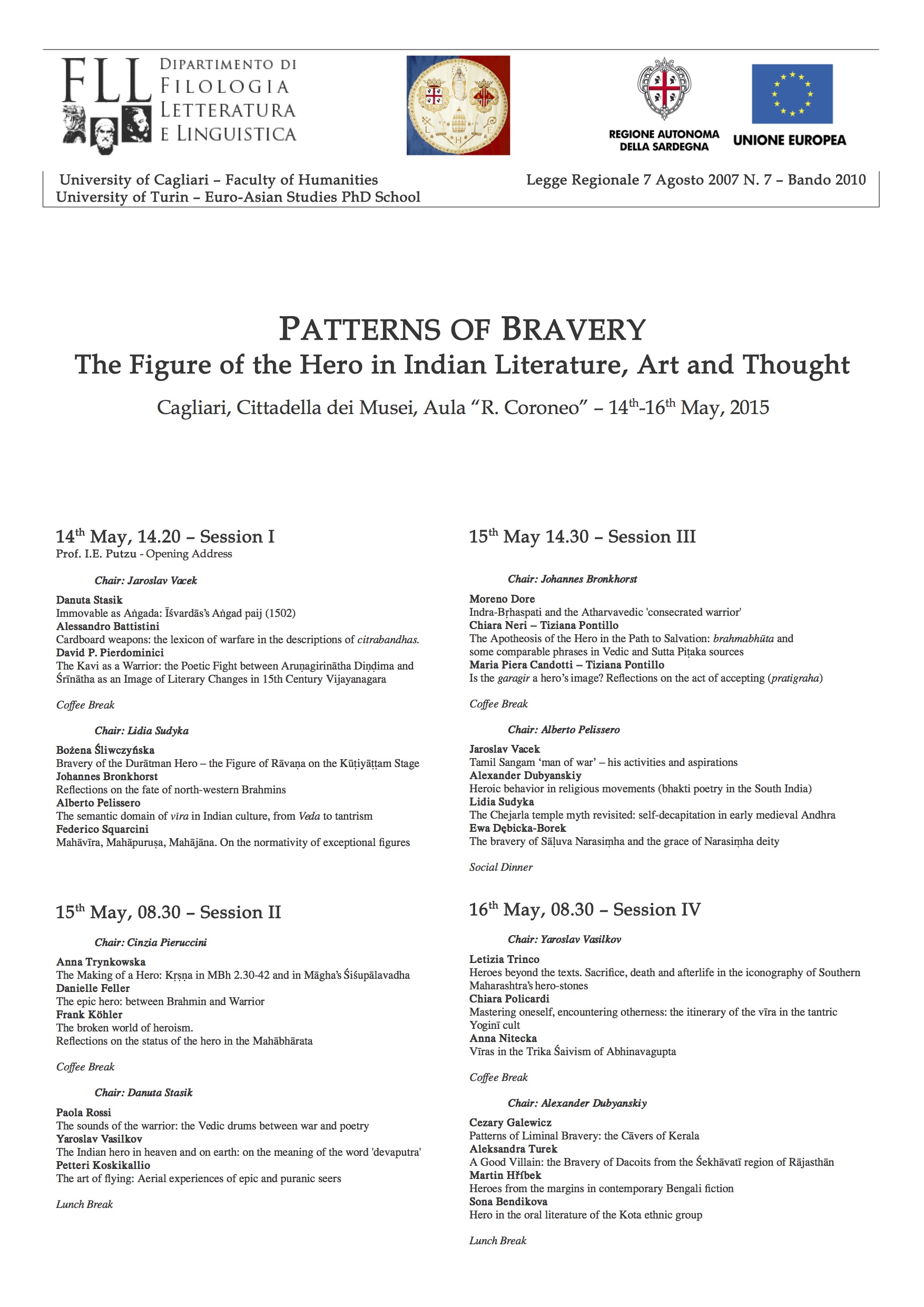
Patterns of Bravery. The Figure of the Hero in Indian Literature, Art and Thought

Cagliari, 14th--16th May 2015

Tiziana Pontillo signalled me the conference mentioned in the title. You can download the flyer here.
Locandina
From the point of view of methodology, let me praise T. Pontillo for the fact that she will give two joint papers. Let us all learn from each other and dare more cooperative work (if we enjoy it)!

Forging Indian philosophical texts

Did Indian authors forge their authorities? Did they need it, given the freedom commentators enjoyed (so that Śaiva texts have been used by Vaiṣṇava authors (see the Spandakārikā) and dualist texts by non-dualist authors (see the Paratriṃśikā) as their authorities)?