The Gonda Fund for Indology awards fellowships to promising young Indologists at post-doctorate level, that enable them to spend one to six months at the International Institute for Asian Studies (IIAS) in Leiden, the Netherlands.
The Gonda Fund also offers funding for publications and research projects in Sanskrit or other Indian languages and literatures, and in Indian cultural history.
The deadlines to apply for a fellowship or for funding of a research project or publication are 1 April and 1 October of every year.The Gonda Fund is a foundation of the Royal Netherlands Academy of Arts and Sciences.
More information is available at www.knaw.nl/gonda-fund.
A chart of the “History of Eastern Philosophy”
Most readers will have already noted this chart of “Eastern Philosophy” at Superscholar.
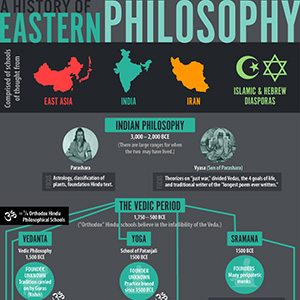
Now, I have already commented about it at DailyNous, but the staff of Superscholars has written to me twice to advertise the map, so that I feel compelled to repeat my comment and some further ones here. I would also like to ask readers: Do you think these maps have some use at all? If so, for whom? Beginners or Advanced scholars?
Daya Krishna’s “Creative Encounters with Texts”
Daya Krishna was an Indian philosopher, a rationalist and iconoclast, who constantly tried to question and scrutinise acquired “truths”. The main place for such investigations was for him a saṃvāda ‘dialogue’. That’s why he also strived to organise structured saṃvāda inviting scholars from different traditions to debate about a specific problem. The minutes of such dialogues have been published in Saṃvāda and Bhakti.
The origins of Hayagrīva
The Hayagrīva (horse-head) form of Viṣṇu is slightly disturbing, not only for his half animal aspect (a characteristic shared by various other avatāras, from Narasiṃha to Matsya), but also for the fact that the horse head does not find a proper justification in most texts… And when it does find one, I strongly suspect that it is an ad hoc explanation, in order to solve the riddle. Let me elaborate a bit more:
Sanskrit Lecturer at Princeton!
SANSKRIT LECTURER, PRINCETON UNIVERSITY PROGRAM IN SOUTH ASIAN STUDIES
The Program in South Asian Studies at Princeton University is accepting applications for a full-time, three-year lecturer position in Sanskrit (with possibility of renewal) beginning September 1, 2015.
The 169th Philosophers’ Carnival is online! Among several other interesting things, it has some lines on the interpretation of an alien Philosophy and on the Skholiast‘s contribution to the “doing philosophy in a polycentric world” debate (about which see also this post on the Indian Philosophy Blog).
For personal reasons, I am also happy to see also a link to Gabriele Contessa’s plea for a more inclusive policy of inclusion of philosophers who do not have English as their first language. Why should this be important? Apart from the fact that it is fair to include everyone, independent of their (race, gender, sexual preferences… and) native tongue, inclusion of different perspectives is part of the enterprise of ideodiversity, which is what we (=scholars of non-Western philosophies) are all engaged with, isn’t it?
What is a body? Veṅkaṭanātha on plants, rocks, and deities
In general, classical Indian philosophers tend to define śarīra ‘body’ as a tool for experience (bhogasādhana). Thus, many philosophers state that plants only seem to have bodies because of our anthropomorphic tendencies, which make us believe that they function like us, whereas in fact plants cannot experience. By contrast, Veṅkaṭanātha in the Nyāyasiddhāñjana defines śarīra in the following way:
Where to publish a book on Sanskrit (or) Philosophy?
Where should one publish one’s book? What are advantages and disadvantages of each venue? I will start sharing my views and would be glad to read yours (PLEASE NOTE that I cannot be exhaustive and in this sense I depend on my readers —suggest further venues or important points, if you deem them relevant).
Please remember that I am speaking about young authors (well-known ones will not need me).
…of the last year (that is, written after November the 9th 2013) here, before November the 17th.
Unfortunately, only the 100 most voted posts will be evaluated. It would be nice if a post dealing with non-Western philosophy could be at least nominated among those 100, so check whether you can support one which has already some votes!