The Laternendecke (called “Dome of Heaven” in Soper 1947, see image for a wonderful example)
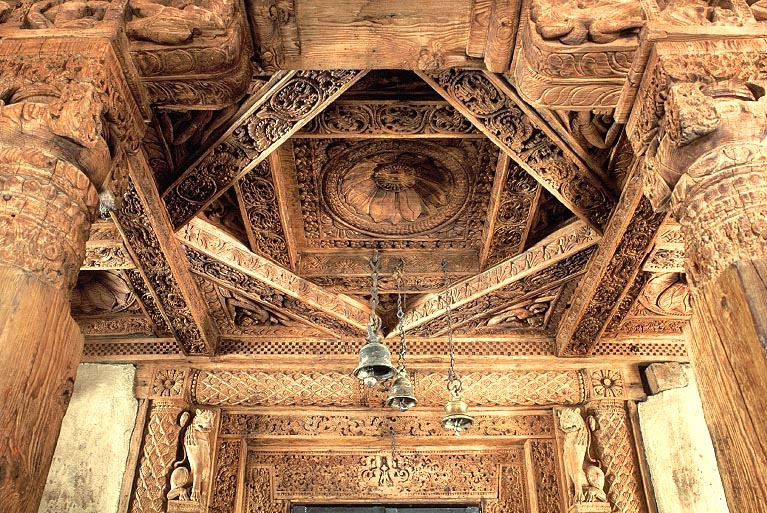
Wooden ceiling of the Mandapa in the Lakshana Devi Temple at Bharmaur, c.700. Photo by Takeo Kamiya
are a way of covering small rooms. In a 2011 article, Gerald Kozicz shows how it has started as a practical solution in areas where wood was scarce, since the Laternendecke made it possible to use also shorter and weaker branches, together with mud. This confirms that its area of origin is Central Asia, from the Aral lake to Punjab. Originally, the Laternendecke had an opening in the middle, which served as a way out for smoke and as a source of light for the room.
In India, this opening has been instead replaced by a circular lotus. This substitution already hints at what happened to the Laternendecke: as can be observed in this wonderful image, this originally practical solution led to wonderful architectonical executions, of great esthetic and symbolic value.
That the Laternendecke has been reused although there was no practical need of it, is due, Kozicz explains, to its symbolic resemantization. The central lotus hints at an axis mundi, around which the cosmos, in the form of concentric squares, rotates. The similarity with other concentric structures, from the Buddha’s nimbus to the maṇḍalas, will not go unnoticed.
Back to Central Asia, the Laternendecke has been reused also where it made no structural sense, e.g., in the caves of Bamiyan, and in other rock- and cave-structures. Since Bamiyan was a central focus in the commercial routes, since the time of the Kuśānas, the Buddhist symbolic language, together with the Laternendecke, could reach the Taklamakan area and last also China.
Interestingly enough, in China the motif has been reused in still a different way, i.e., as simply a flat decorative element.

The flat Laternendecke in a Chinese cave. Photo from www.cavetemples.com
The Islamic conquerors in South Asia often destroyed, out of their iconoclastic tendencies, many Buddhist and Hindu sites, but the floral motif of the lotus could be easily incorporated in their decorative patterns, as Kozicz shows in the case of a Laternendecke originally “Hindu” and integrated in the Adina Mosque in West Bengal.
Finally, the Laternendecke reaches its greatest potential in Ladakh (Kozicz, p. 53), which had witnessed around 1000 a new golden age due to the collapse of other easier routes, which had been occupied by the Islamic invaders. Here the Laternendecke has some variations (e.g., with trapeziums instead of triangles on the periphery of the bigger square) and more importantly it becomes a way to depict whole maṇḍalas in a three-dimensional way. Buddhas are depicted in the vertical spaces, so that they can actually look at the centre of the maṇḍala (the lotus, here used as a Mahāyāna-Vajrāyāna symbol).
Thus, the Laternendecke has a long history of reuse and risemantizations, interestingly enough some of them have occurred through the same elements (such as the lotus at the centre), which have acquired a different value in Hindū, Buddhist or Islamic context.
Kozicz’ article (as usual in his works) includes beautiful images and architectonic schemes.
Gerald Kozicz, “Die Laternendecke: Von den Höhentempeln Bamiyans zu den Stupas von Alchi”. In: Robert Kostka (ed.) Wakhan. Talschaft zwischen Pamir und Hindukusch. Graz 2011 (you can download it freely from this link).
Friday is reading day on this blog. For my monthly planning, see here.
Does God have a body? And in which sense? Have a look at the whole problem, from the point of view of Western philosophy, but with an answer inspired by Vedānta Deśika in this post of mine.